It’s hard to look away from the reality that the modern gaming landscape is entrenched in safe bets and risk-free products, especially when looking at the output of the industry’s big players. Live-service multiplayer games reign supreme, sequels and remakes are a dime a dozen, and most players themselves are entrenched in proven mega-hits from years ago. We’re lucky, then, that the emergence of a strong independent scene has played a vital role in helping push away some of this malaise, with treasure troves of highly experimental games free from the restrictions plaguing larger companies that must balance creative desire with shareholder interests.
One such example of this indie rebellion of sorts is Tomas Sala, solo developer of The Falconeer and Bulwark: Falconeer Chronicles, the first two parts of a now-confirmed trilogy all set within the oceanic world of Sala’s creation. I had the pleasure of sitting down with Tomas last year to talk about both games and his wider experiences as a solo developer on my Games PR-focused podcast. I found his insights on the choice to release a Bulwark: Falconeer Chronicles ‘evolving demo’ truly fascinating, with the decision leading to the game’s development evolution taking place in front of players’ eyes as they played.
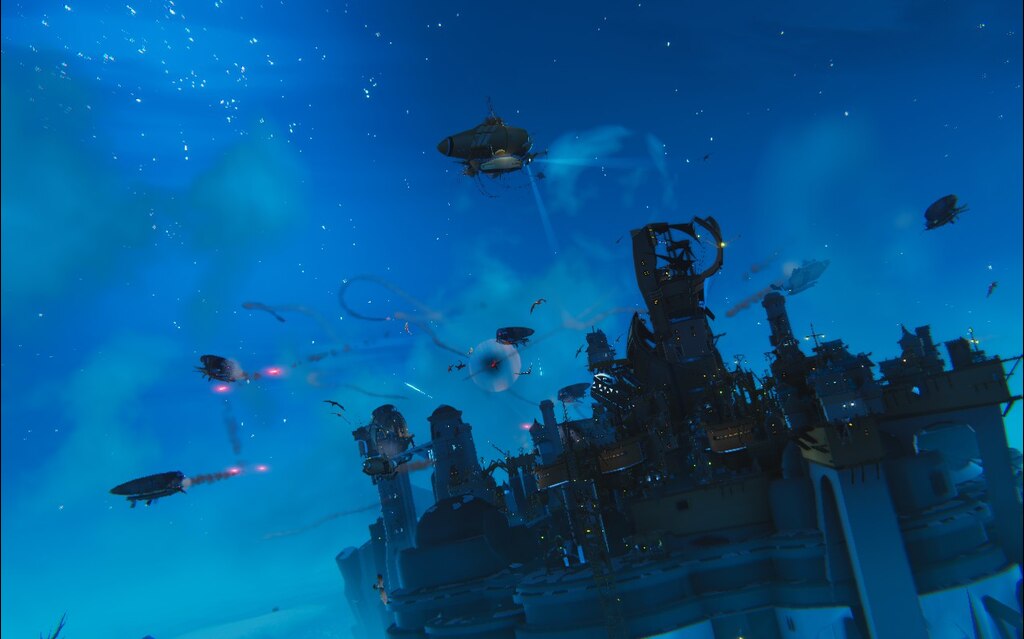
What’s an evolving demo? Well, it’s a demo that evolves; basically, I kid, seriously though, over the span of many months, this fully featured version of the game grew and morphed in front of your eyes, with Sala adding new features, adjusting existing ones, and building his creation on a near daily basis. This development was guided by player feedback, akin to an ‘Early Access’ model but without the initial fee and leap of faith. An unusual model for sure, but it reflects Sala’s creative process and is something that I’d love to see more of, especially in the indie space. And with that, let’s dive into Bulwark: Falconeer Chronicles…
– Ursee Sala’s Vision –
Bulwark: Falconeer Chronicles is, by definition, a city-building game. You construct giant settlements that rise from the encrusted archipelagos that remain in the war-torn world of the Falconeer Chronicles; there are resources to discover and manage, and of course, populations to flourish and control. However, in a genius move that makes you question Bulwark‘s very position as a city-builder, the entire focus of your time on the Great Ursee is building epic structures whilst removing the vast majority of the baggage that the traditional city-builder can often be dragged down by. So it’s not a city-builder, then? If we’re really going to squeeze it in somewhere it’s hard to look elsewhere, but Bulwark shirks this tag at every opportunity, and it is all the better for it.
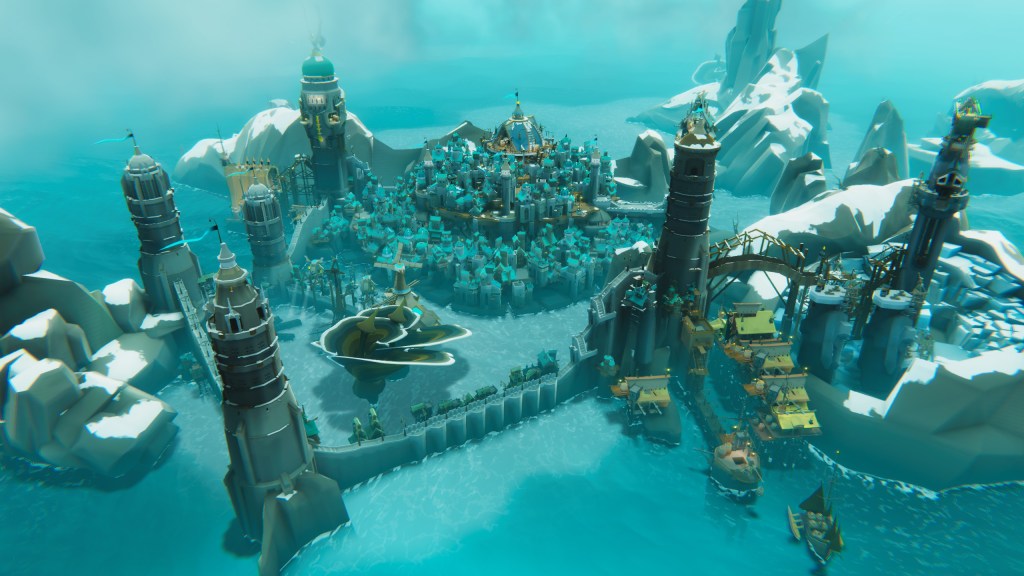
Genre staples such as acute resource management are reinvented with a touch of Sala’s own creative nature that challenges your assertions of what to expect from an experience like this; more on this later. To me, every choice in Bulwark‘s development reflects Sala’s mission statement – emboldening each player to make mistakes and build cityscapes with little to no limits. Making mistakes in Bulwark is impossible, and it’s easy to dismantle and rebuild if you find yourself dissatisfied with what you’ve constructed. Instead of placing an acute focus on micro-managing every last detail of development, akin to that seen in titles such as Cities Skyline, FrostPunk, and Farthest Frontier, your attention here is placed on figuring out how creative you can be in design.
The freedom to express yourself in Bulwark is seldom seen in modern games. Emboldened by the lack of punishment for experimenting and the brilliant controls that offer unprecedented ease of play without removing any of the depth that would hamper the player’s freedom, Bulwark enables everyone who steps into its vast oceanic world to feel an overwhelming ability to just create. Those creations are beautiful, too, and there’s enough under the surface to ensure a near-limitless volume of individuality within each player’s settlements…
– Teetering On The Edge –
As should be expected in the world of The Falconeer, in which a devastating war has left the Great Ursee devoid of life and clinging to the remaining pockets of civilisation, precarity is ever-present in Bulwark. Existing as a counterforce to the player’s creativity, each settlement you raise on the Great Ursee is in a constant duel with the forces of nature that surround you. Unlike the flat and stable environments that beckon you in your typical city-building game, the world of Bulwark is composed of near-endless expanses of ocean, only interrupted by daunting cliffs and uneven rocky archipelagos. It’s unwelcoming by design and presents a landscape that refuses to be tamed by your desires.
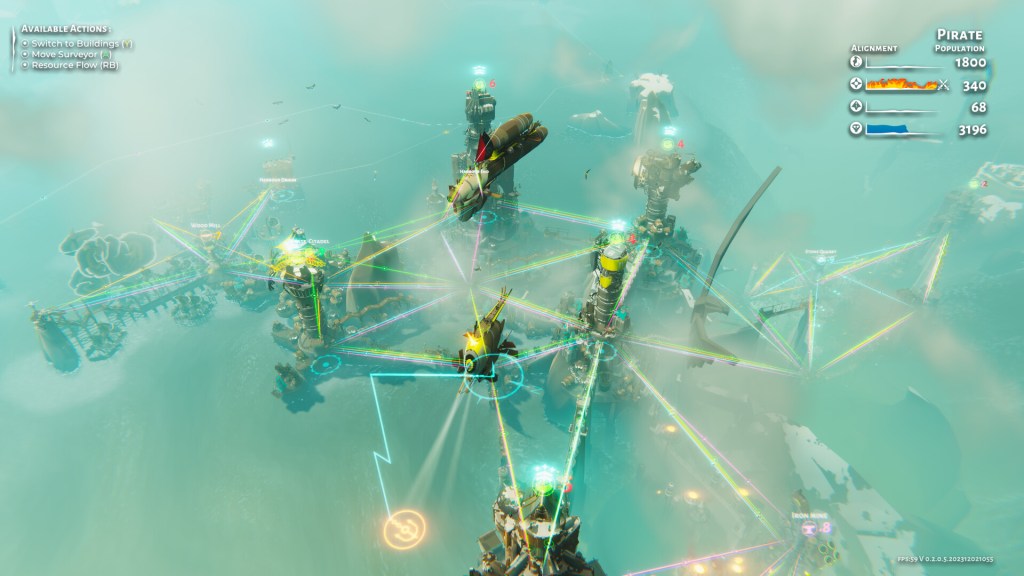
It reflects the civilisations of the Great Ursee, too, all fighting the stormy seas and unsteady rock faces that they now call home and each other at times. Bulwark challenges you to overcome adversity and grow civilisations in spite of the world around you, not because of it. In another step away from city-building traditions, these settlements grow vertically rather than horizontally, with an awkward combination of towers, walkways, gantries and walls crossing back and forth across one another as you build on the precarious plot of land you and your people have made home.
The Great Ursee is vast, but there’s safety in familiarity, and your first hours in Bulwark will likely be spent reinforcing and developing the same small settlement that you established in your first minutes in the game. And when it’s time to go exploring? Once again, you’ll find yourself heading upwards, climbing into the stormy skies in your flying surveyor, a mobile home-from-home of sorts. Developing your settlement and consequently having the ability to flex your creative muscles demands resources dotted across the Great Ursee, so you’ll need to cautiously step away from the safety of your home to fuel the expansion.
Access to these materials allows wooden towers and rickety walkways to make way for more robust stone and iron, courtesy of some simply sublime animations and brilliant, easy-to-use controls that once again highlight Sala’s game design genius. Building new towers and the paths that connect them is ridiculously intuitive. Draw a line, press build, and watch your creation spring up in front of your eyes in rapid motion. Wood, stone and iron smash together as bare rock and nature make way for man’s teetering creations. Shelters are constructed, command towers are raised, waves crash against the fortifications, and your Bulwark expands.
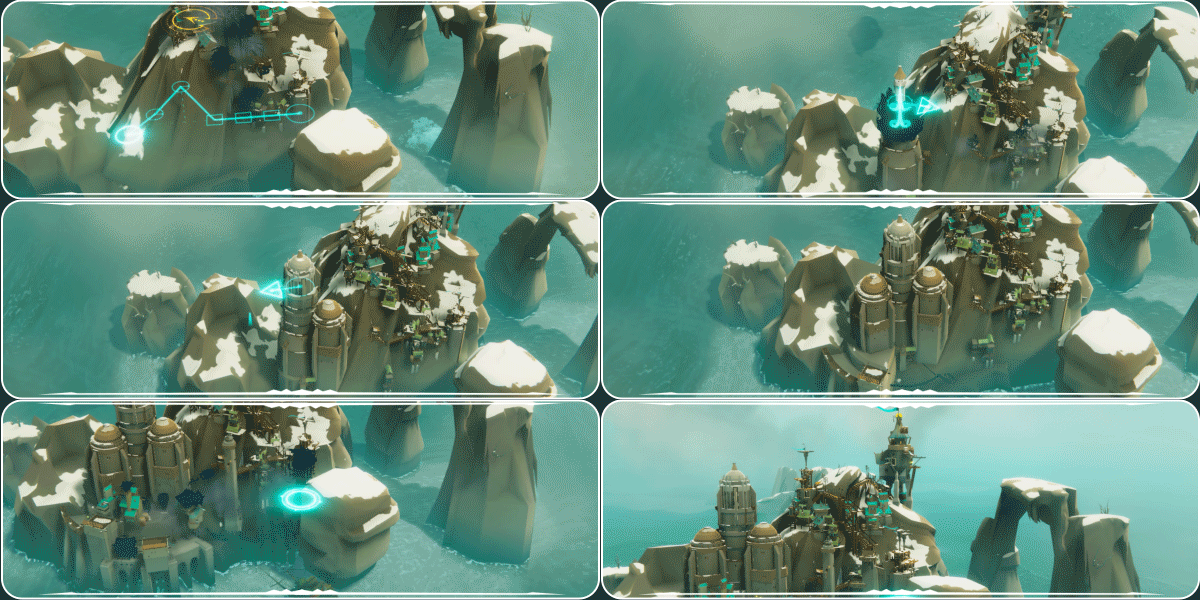
One of the subheadings on the game’s Steam page is ‘Paint the landscape’, and it couldn’t be a more true reflection of everything this fantastical experience has to offer. Watching unstable monolithic structures emerge from nothing never gets old. It’s also a reiteration of Sala’s commitment to freedom first gameplay that resonates throughout every moment I have experienced with Bulwark. The creation tools are simple, even if their results are far from it, and its a testament to carefully curated game design that despite this core formula changing very little, Bulwark continues to engage and delight me even tens of hours into my time with it.
– Submerging Yourself Into These Waters –
What truly sells the Bulwark experience is the tremendous job Sala has done at crafting a truly delectable atmosphere within this dangerous world. A bombastic soundtrack from Benedict Nichols manages to mesh epic themes of exploration with dangerous trepidation to tranquil tones, and a sprinkling of hammering war drums greets you every step of the way. It’s hypnotic at times and has become a mainstay in my current rotation (we need a vinyl); it’s honestly so good that it’s almost worth the entrance price alone.
The wider audio design is equally brilliant, from the satisfying sound effects given to tower construction and the reinforcement of walkways as you continue to scale up your settlements to the crashing sounds of larger-than-life waves crashing against your trade-ships as they journey across the treacherous Great Ursee carrying vital resources for your ever-expanding and flourishing civilisation. Bulwark is a game that deserves a great pair of headphones or surround sound in a darkened room.
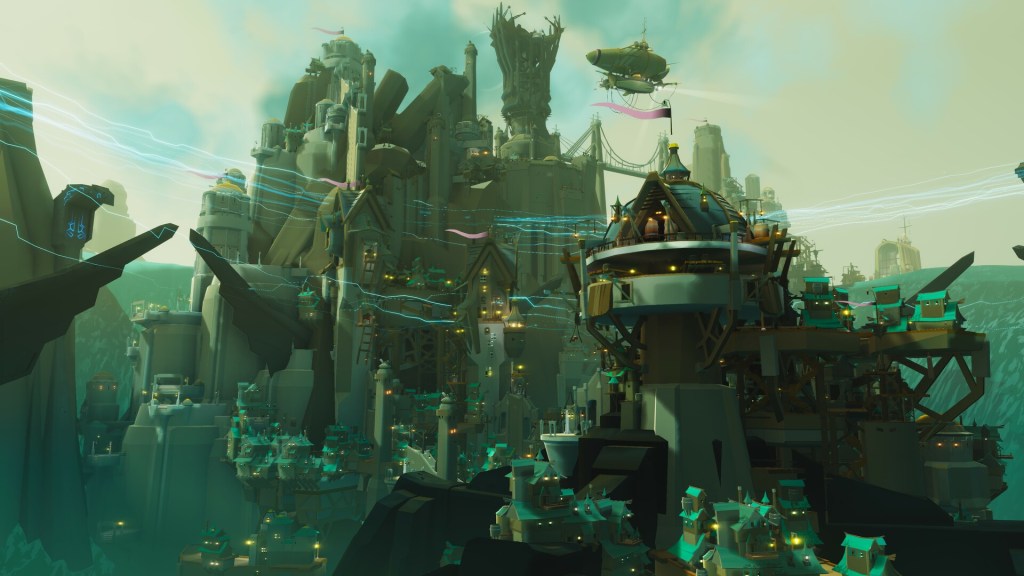
The audio presentation works hand in hand with a steadfast visual design that brilliantly reinforces that sense of precariousness that oozes throughout Bulwark. Each building or walkway you construct, from humble wooden foundations to towering iron structures that scrape the skyline of the Great Ursee, exists despite the inhospitable world surrounding it. In a way, it feels almost brutalist, the clashing of man and nature; your Bulwark exists in direct opposition to the world, which is reflected in how Sala presents it to you. Everything man-made in this world grips the small slithers of land that punches through the sea like barnacles on the hull of a rickety old sailing boat
There’s little to no cluttered UI in Bulwark, either. Instead, Sala opts for a system that very much places you within the Great Ursee itself, as opposed to existing as an observer from above. It further showcases Bulwark’s emphasis on developing a ‘lived-in world’ for players to immerse themselves in. This is also supported by the sandbox approach to storytelling that removes an overarching established narrative in favour of one that you, the player, guide forward based on your choices to form alliances, engage in conflicts, and build your settlement populations based on the numerous factions within the game. It ensures that every choice you make has real consequences, and opens up a lot of role-playing potential where you can steer each adventure in the Great Ursee however you see fit. Once again, the expression of player freedom lies at the forefront of Bulwark‘s mission.
– Architecting Your Own Creativity –
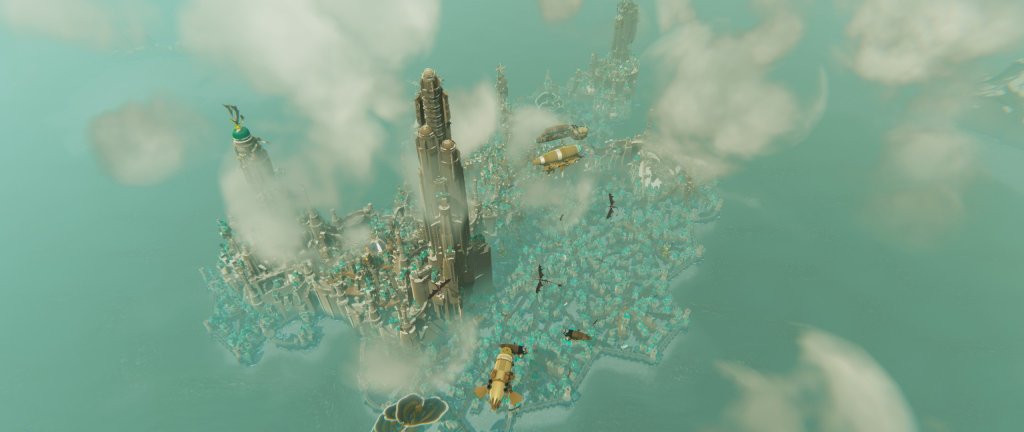
In my own opinion, Bulwark transcends the traditional concept of a video game, and I question the decision to ‘review’ it within that established framework. It isn’t an experience that warrants an ‘X/10’ as such; it’s a canvas for unfettered artistic expression. There isn’t a focus on conquering challenges, button mashing your way through cutscenes, or seeing the 100% pop-up on a save file in the vast and haunting landscapes of the Great Ursee; victory takes on a new form.
The player isn’t defined by their progress towards an end goal but by the awe-inspiring creations they bring to life during the process of play. Bulwark empowers players to become architects of their own ingenuity, fostering a sense of wonder and accomplishment unlike any other. It’s an invitation to lose yourself in the joy of creation, a testament to the boundless potential of the human imagination if given the tools to harness that very imagination in an intuitive manner.
This artistic freedom extends beyond simply building structures. Sala has crafted a world steeped in his own creative vision. Every element, from the windswept cliffs to the perilous waters, feels imbued with a sense of wonder. As you build within this world, it feels like an extension of Sala’s imagination coming alive before you. This symbiotic relationship between player and developer creates a truly immersive experience that celebrates the power of creation and the boundless potential that lies within us all.
 Tom's World
Leave a comment